FITI GROUP
ESG

Stakeholders

Material Topics

1. Materiality Assessment Process

① Topic Identification

  • ※ In 2023, a total of 21 material topics were identified. Following trend analysis and industry benchmarking, the list was revised and expanded to 24 topics in 2024, in alignment with international ESG developments.
  • ‧ "Anti-corruption and Anti-competitive Behavior" revised to "Integrity in Business Operation"
    ‧ "Supplier Environmental Assessment" revised to "Supply Chain Management"
    ‧ "Labor/Management Relations" revised to "Talent Attraction and Retention"
    ‧ "Training and Education" revised to "Talent Attraction and Retention"
    ‧ "Non-discrimination and Employee Diversity" and "Equal Opportunity" consolidated and renamed as "Employee Diversity, Equity and Inclusion"
    ‧ New topics added: "Risk Management," "Product R&D and Innovation," "Customer Relationship," and "Climate Change Response."
  • Sustainability Management Standards:
    Our sustainability management approach integrates business operations, strategy, and industry analysis, and is guided by the following frameworks and standards:
    ‧ AA1000 Stakeholder Engagement Standard (AA1000 SES)
    ‧ GRI Standards 2021
    ‧ Sustainability Accounting Standards Board (SASB)
    ‧ Sustainability Disclosure Indicators and Industry-Specific Disclosure Requirements issued by the Financial Supervisory Commission (FSC), Taiwan
    ‧ United Nations Sustainable Development Goals (SDGs)
    ‧ Responsible Business Alliance (RBA) Code of Conduct

② Stakeholder Survey on Material Topics

  • Attention (Relevance) Survey:
    A total of 305 questionnaires were collected:
    ‧ Employees: 211
    ‧ Contractors/Suppliers: 50
    ‧ Investors/Shareholders: 20
    ‧ Government: 6
    ‧ Customers: 6
    ‧ Communities: 6
  • Impact Assessment Survey:
    A total of 22 questionnaires were collected.
    The assessment was conducted by members and secretariat of the Sustainability Committee, as well as managers at the division level or above, evaluating the impact of each topic on the Company’s operations and sustainable development.

③ Double Materiality Analysis

  • Importance Analysis:
    Identified the top 5 material topics of concern for 7 major stakeholder groups.
  • Impact Analysis:
    ‧ Evaluated each topic’s impact and likelihood across nine dimensions relating to the organization’s operations and sustainable development.
    ‧ The Sustainability Committee and secretariat defined both the positive and negative impacts of each topic.
  • Materiality Matrix:
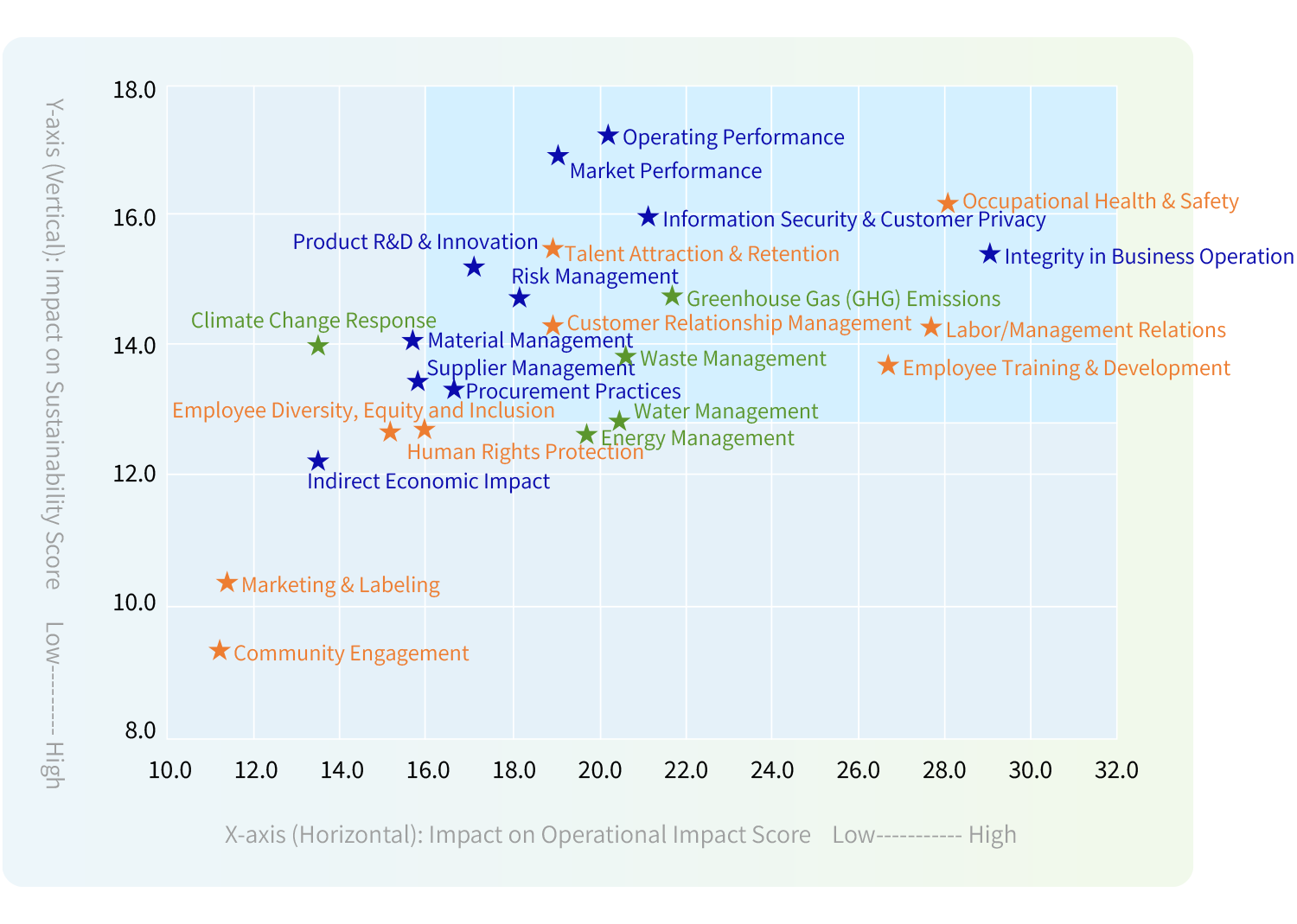
    A three-dimensional matrix was developed, integrating stakeholder attention, operational impact, and sustainability impact. From this analysis, 10 material topics with medium-to-high significance were identified.

④ Material Topic Management Approach

  • ‧ Candidate material topics identified through the materiality assessment were submitted to the Sustainability Committee for validation and approval.
  • ‧ For the 10 prioritized material topics, the responsible departments were assigned to establish corresponding management approaches and to report progress on a regular basis to the Sustainability Committee.
  • ‧ The 10 material topics were disclosed in the Sustainability Report, in alignment with the GRI Standards’ materiality principles.
  • ‧ The Company disclosed stakeholder concerns, engagement methods, and communication outcomes on its official website to ensure transparency and accountability.


2. Questionnaire Results Analysis

FITI conducted its materiality assessment in accordance with the GRI Standards 2021, with reference to the Value Balancing Alliance (VBA) impact assessment methodology and the European Financial Reporting Advisory Group (EFRAG) Double Materiality principle. The assessment considered both the positive and negative impacts of our activities on external sustainable development, as well as the impacts of external sustainability issues on our operations.
A total of 305 stakeholder questionnaires on issue relevance and 22 internal questionnaires on operational and sustainability impact were collected, the latter completed by members and secretariat of the Sustainability Committee, as well as managers at the division level and above. Taking into account required disclosure items under SASB and the FSC Sustainability Disclosure Guidelines, the weight of operational impact was set at 50%. The results were categorized into five levels (Very Significant, Significant, Moderate, Minor, and Insignificant). Issues with a weighted score above 270 were identified as material topics.
Ultimately, 10 material topics with medium-to-high significance were identified:
‧ Occupational Health and Safety
‧ Integrity in Business Operation
‧ Labor/Management Relations
‧ Employee Training and Development
‧ Operating Performance
‧ Information Security and Customer Privacy
‧ Greenhouse Gas (GHG) Emissions
‧ Talent Attraction and Retention
‧ Waste Management
‧ Customer Relationship Management

lthough Market Performance also exceeded the threshold score of 270, the Sustainability Committee decided not to include it as a material topic. Instead, related information is disclosed in the “Compensation and Benefits” section of this report.

The identified material topics play a critical role in FITI’s management direction, risk control, and strategic opportunities:

(1) Corporate Governance and Operations:
‧ perating Performance: Directly affects revenue growth and investor confidence. Stable profitability supports employee and customer trust. With capital expenditures from overseas expansion, financial impacts must be carefully evaluated alongside local environmental and social considerations.
‧ Information Security and Customer Privacy: A key factor for operational stability and customer trust. In response to increasing cyber risks, FITI strengthens systems and employee awareness to mitigate risks and meet stringent compliance requirements.
‧ Integrity in Business Operation: Strengthening internal control and regulatory compliance is fundamental to maintaining corporate reputation and reducing operational risks. Suppliers are also required to comply with integrity standards to mitigate risks across the value chain.
‧ Customer Relationship Management: Closely linked to customer satisfaction and market competitiveness. By proactively addressing ESG expectations, FITI enhances customer loyalty and drives supply chain partners to improve climate action and sustainability performance.

(2) Environmental Management:
‧ GHG Emissions and Waste Management: Essential for advancing net-zero goals and regulatory compliance. While requiring capital investment in equipment upgrades, these efforts generate long-term energy-saving and carbon-reduction benefits, lower future carbon tax and environmental liability risks, and strengthen environmental resilience across the supply chain.

(3) Workplace Well-being and Talent Development:
‧ Occupational Health and Safety: Directly impacts employee well-being and operational stability. High standards of safety management reduce workplace incidents, mitigate operational disruptions, and strengthen employee commitment and cohesion.
‧ Talent Attraction and Retention: Together with labor/management relations, these factors are crucial to competitiveness. Attractive compensation packages and effective communication improve retention, knowledge transfer, and workforce stability.
‧ Employee Training and Development: Central to fostering innovation and quality enhancement. Ongoing capacity building and career development pathways strengthen technical expertise and meet external expectations for talent sustainability.

In summary, these ten material topics represent the key risks and opportunities currently faced by FITI. Through integrated management and effective stakeholder engagement, the Company will continue to monitor trends, enhance resilience, and pursue sustainable growth in tandem with long-term corporate value creation.


No. Top 10 Topics for 2024, Ranked by Materiality
1. C5. Occupational health and safety Occupational health and safety
2. A5. Integrity in business operations Integrity in business operations
3. C4. Labor/Management relations Labor/Management relations
4. C3. Employee training and development Employee training and development
5. A1. Operating Performance Operating Performance
6. A6. Information security and customer privacy Information security and customer privacy
7. B4. Greenhouse Gas Emission Greenhouse Gas Emission
8. C2. Talent attraction and retention Talent attraction and retention
9. B5. Waste management Waste management
10. A9. Customer relationship management Customer relationship management
Environment Social Governance
Dual Materiality Matrix
3. Materiality Management Policy

Topic 2024 Performance 2025 Target 2026 Target 2030 Target Management Policy and Approach
Integrity in Business Operation GRI 206 No Integrity Violations No Monopoly/Anti-Competitive Incidents No Monopoly/Anti-Competitive Incidents No Monopoly/Anti-Competitive Incidents • Following the Code of Integrity for Listed Companies, the company has internally established a Code of Ethical Business Conduct, a Code of Ethics, and an Antitrust Management Procedure. Through a comprehensive internal audit and control system, the company enforces strict self-discipline, transparently discloses governance outcomes, and accepts public and societal supervision.
Operating Performance GRI 201 • Operating gross margin: 26%; operating net margin: 16%; earnings per share (EPS): TWD 25.22.
• Taiwan site employees participated in a total of 7 engagement sessions, including labor-management meetings, welfare committee meetings, and general mobilization meetings.
• Investors and shareholders participated in a total of 7 engagement sessions, including investor conferences and shareholder meetings.
Annual budget targets approved by the Board at year-end were fully met (100%). Annual budget targets approved by the Board at year-end were fully met (100%). Maximizing Benefits for All Stakeholders • The management unit is responsible for overseeing budgets and expenses, ensuring that each department maintains a balance between expenditures and returns while maximizing the company’s overall benefit.
• Each committee group regularly engages with stakeholders and conducts sentiment assessments to better understand stakeholder concerns and provide concrete responses.
Information Security & Customer Privacy GRI 418 Employee signature rate for the Customer Information Confidentiality Agreement reached 100%. 100% of employees signed the Customer Information Confidentiality Agreement. No customer complaints related to privacy No customer complaints related to privacy • Organizational adjustments were made, including the appointment of a Chief Information Security Officer and the establishment of a dedicated cybersecurity department, creating a comprehensive cybersecurity management framework.
• Planned 36 cybersecurity enhancement measures, implemented in short-, medium-, and long-term phases, with regular reporting to the committee.
One major cybersecurity incident occurred (please refer to the Customer Privacy and Information Security section). No low-impact major cybersecurity incidents reported No low-impact major cybersecurity incidents reported No low-impact major cybersecurity incidents reported
Customer Relationship Management GRI 418 GRI 416 Customer satisfaction score: 4.16 Customer satisfaction score of 4 or higher Customer satisfaction score of 4 or higher Customer satisfaction score of 4.2 or higher • Continuously monitor customer feedback through external customer meetings, business performance evaluations, and internal management review meetings to meet customer expectations regarding product quality and ESG performance.
• In line with customer requirements, we continuously manage environmental and health risks of product components and manufacturing processes, as well as conduct carbon assessments, to minimize potential negative impacts on customer health and safety throughout the product life cycle.
Topic 2024 Performance 2025 Target 2026Target 2030 Target Management Policy and Approach
Greenhouse Gas Emissions GRI 305 • The performance of the Kezhong site is measured using intensity indicators
• Scope 1 and Scope 2 emission intensity at the Kezhong site decreased by 33.56% compared with 2023
• The Songjiang and Kunshan sites are expected to complete third-party assurance by the end of 2025; currently, only Scope 2 emissions are disclosed
• Completed third-party verification of ISO 14064-1 for the Songjiang and Kunshan sites
• Completed self-verification of ISO 14064-1 for the UC site
• Scope 1 and Scope 2 GHG emissions from the Kezhong, U.S. Office, Songjiang, and Kunshan facilities decreased by 12.6% compared with the base year
• Establish GHG reduction plans for the Group and each site
• Completed third-party verification of ISO 14064-1 for the UC site
• In response to FITI’s requirement to prepare sustainability disclosures in accordance with IFRS S1 and S2 standards by 2028, planning to initiate compliant Scope 3 disclosures by category starting in 2026
• Completed ISO 14064-1 third-party verification across all Group facilities
• Reduced GHG emissions by 50% compared with 2023
• Targeting an 80% reduction in GHG emissions by 2040 compared with the base year, and achieving net-zero emissions by 2050
• Establish internal carbon management mechanisms, including annual reduction targets and medium- to long-term reduction goals, with continuous tracking and evaluation of emission reduction performance
• Conduct regular GHG inventories to monitor emission data
• Strictly comply with national and local regulations and standards related to GHG emissions, ensuring transparent and compliant management measures
• Provide regular employee training to enhance awareness and skills on emission reduction and low-carbon transition
• Collaborate with suppliers and partners to drive low-carbon transformation across the value chain
Waste Management GRI 305 GRI 306 • The waste intensity for this reporting year was 0.1821 metric tons per NT$ million, representing a 17.93% reduction compared with the reference value of 0.222 metric tons per NT$ million.
Waste intensity is less than or equal to the reference value of 0.222 metric tons per NT$ million • Waste intensity is less than or equal to the reference value of 0.222 metric tons per NT$ million
• Achieved 100% audit rate for waste disposal contractors
Waste intensity is less than or equal to the reference value of 0.222 metric tons per NT$ million • Establish clear pollutant discharge targets and action plans based on national standards and FITI’s operational conditions.
• Implement a comprehensive waste segregation and collection system to promote resource recovery and reuse, thereby reducing overall waste generation.
• Store, treat, and dispose of waste in compliance with applicable environmental regulations to prevent secondary pollution.
Topic 2024 Performance 2025 Target 2026Target 2030 Target Management Policy and Approach
Occupational Health & Safety GRI 403 Lost-time Injury Frequency Rate: 1.71 cases per million working hours Lost-time injury frequency rate ≤ 1.70 per million working hours Lost-time injury frequency rate ≤ 1.67 per million working hours Lost-time injury frequency rate ≤ 1.53 per million working hours • Conduct regular workplace risk assessments to systematically identify potential occupational hazards.
• Establish a hazard reporting mechanism to ensure timely detection and management of risks.
• Hold periodic safety operation and emergency response training to ensure all employees are familiar with operating procedures and emergency measures.
• Strengthen employee safety education to enable quick mastery of relevant safety regulations.
Lost-time injury severity rate: 34 days per million working hours Lost-time injury severity rate≤32 days per million working hours Lost-time injury severity rate≤31 days per million working hours Lost-time injury severity rate≤29 days per million working hours
Labor/Management Relations GRI 402 • Human Rights Grievances:
- Internal grievances: 0 cases
- External grievances: 0 cases
• Fines for violations of human rights or labor practices: 0 cases
• RBA (Responsible Business Alliance) training completed: 417 participants
• Freedom of Association and Communication Channels:
- Labor-management meetings: 4 sessions
- Employee welfare committee meetings: 2 sessions
- Total number of employee associations/clubs: 4
- All Hands meetings: 1 session
- Internal communication mailbox submissions: 2 cases
• Maintain zero violations of labor regulations and zero penalty records
• Regularly convene labor-management meetings and employee assemblies to facilitate communication and consultation
• Complete training on the RBA Code of Conduct, with at least 500 participants trained annually
• Promote a company-wide mechanism for assessing human rights and labor-management risks
• Implement localized gender equality and workplace-friendly policies across overseas sites
• Enhance employee participation in labor-management issues and increase employee involvement in community/association activities
• Integrate human rights and labor-management communication mechanisms into the ESG risk management framework
• Strengthen internal and external labor-management grievance mechanisms, achieving a grievance satisfaction rate of over 90%
• Commit to full compliance with domestic and international labor regulations, maintaining zero violations and zero penalties to safeguard employees’ fundamental labor rights
• Establish diverse and open communication channels, including regular labor-management meetings, employee welfare committees, suggestion boxes, and grievance hotlines, to foster constructive dialogue between labor and management
• Continuously track and review relevant indicators, incorporating grievance handling efficiency and satisfaction into monitoring, while conducting regular employee satisfaction surveys and using the results as a basis for continuous improvement
• Emphasize the diversity and transparency of labor-management communication mechanisms, strengthening timely and effective dialogue
Employee Training & Development GRI 404 Average training hours per employee per year: 21.9 hours Average training hours per employee per year ≥ 40 hours Average training hours per employee per year: 50 hours Establish a one-on-one mentoring system, with an internal trainer-to-learner ratio of 1:1 • Regularly review the compensation system to ensure market competitiveness
• Foster an open, inclusive, and trusting work environment, providing employees with opportunities to voice opinions and make suggestions
• Implement flexible work arrangements, encourage leave-taking, and promote wellness activities to enhance overall employee well-being
• Develop professional and technical talent with forward-looking vision and innovative capabilities to support business transformation and technology upgrades
• Establish internal training programs covering the latest technology trends, industry standards, and practical applications
• Design career development plans tailored to different technical roles, creating training pathways based on employees’ professional competencies and development needs
Talent Attraction & Retention GRI 401 Turnover rate of high-performing employees: 2.65% Turnover rate of high-performing employees ≤ 2% Turnover rate of high-performing employees ≤ 1.8% Turnover rate of high-performing employees ≤ 1.8%
Retention rate of professional and technical talent :91% Retention rate of professional and technical talent ≥ 92% Retention rate of professional and technical talent ≥ 93% Retention rate of professional and technical talent ≥ 95%