FITI GROUP
ESG

Sustainability Governance

Climate Change Risks and Opportunities

1. Climate-related Risk and Opportunity Identification Process

In response to the impacts of climate change, including physical and transition risks as well as related opportunities, FITI adopts the Task Force on Climate-related Financial Disclosures (TCFD) framework. We also reference major international and domestic climate change assessment reports, such as the IPCC Sixth Assessment Report (AR6) and the World Energy Outlook (WEO), to evaluate potential climate risks and opportunities in 2024.
As FITI moves toward net-zero carbon emissions, risks related to regulations, litigation, and operational costs may rise. Therefore, climate-related risks and opportunities are regularly identified and evaluated across policy, technology, and market aspects to ensure::

Compliance with Laws and Market Trends:Aligning with international regulations and market developments for a low-carbon economy.
Long-term operational resilience:Reducing tax and resource costs, improving adaptability to financial and operational risks.
Stronger capital market and investor support:Responding to ESG requirements and attracting responsible investment.
Greater business opportunities:Leveraging climate initiatives and investment in renewable energy for regulatory and market advantages.
FITI Climate Risk and Opportunity Identification Flow
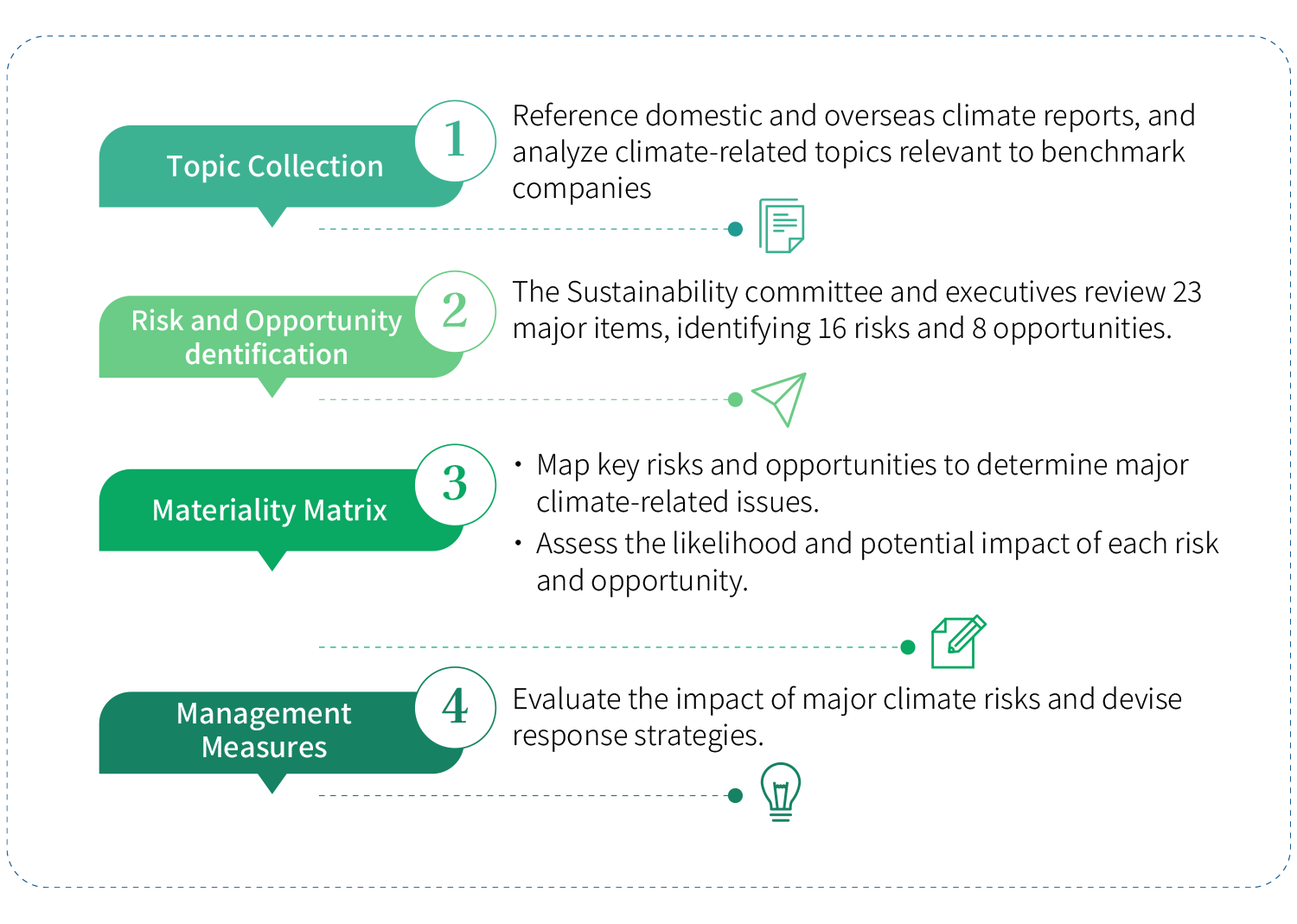

2. Identification Results

FITI Group’s Sustainability Committee referenced recent themes discussed at the United Nations Climate Change Conferences, as well as climate actions implemented by benchmark industries, to identify 16 climate risk topics and 8 climate opportunity topics. Through participation in climate risk and opportunity assessment surveys by committee members, the TCFD task force, and senior management, a risk-opportunity matrix was created to determine the company’s significant climate risks and opportunities. Appropriate mitigation and response measures were subsequently formulated to ensure that all identified significant risks and opportunities are properly managed.
The impact of climate risk topics is evaluated based on the severity of potential consequences and the likelihood of occurrence, categorized into five levels: Extreme, High, Medium, Low, and Negligible. According to the matrix, 8 topics fall within Medium-High or above, ranked as follows: Imbalance in electricity supply and demand; Government implementation of net-zero emission regulations; Increased corporate investment in carbon-reduction technologies; Customer demand for low-carbon or net-zero products; Rising costs of low-carbon raw materials; Increasingly stringent government regulatory measures; Insufficient development of corporate carbon-reduction technologies; Uncertainty or fluctuations in climate-related market signals.

Climate Risks Impact Levels Likelihood of Occurrence
Transition Risks:
Policy & Regulatory Risks
Increasingly stringent government regulatory measures
Implementation of government net-zero emission regulations
Market Risks
Customer demand for low-carbon or net-zero products
Rising costs of low-carbon raw materials
Uncertainty or fluctuations in climate-related market information
Technology Risks
Increased corporate spending on carbon-reduction technologies
Insufficient development or adoption of carbon-reduction technologies
Reputation Risks
Climate-related labor disputes
Negative stakeholder feedback
Adverse media coverage

Physical Risks:
Flooding
Water Scarcity / Drought
Heatwaves / Extreme High Temperatures
Power Supply Imbalance
Rising Temperatures
Sea-Level Rise
• Extreme High: Preventive measures cannot be implemented, or the cost of prevention is unaffordable, making it impossible to reduce casualties or significant property loss.
• High: Difficult to implement preventive measures, or requires substantial resources to reduce casualties or property loss.
• Medium: Preventive measures can be implemented to reduce the risk of casualties or property loss.
• Low: Existing measures are sufficient to prevent casualties or property loss.
• Insignificant: Assessment indicates little to no likelihood of causing casualties or property loss.
• Extreme: Expected to occur within 0–3 years
• High: Expected to occur within 3–6 years
• Medium: Expected to occur within 6–10 years
• Low: Expected to occur within 10–15 years
• Insignificant: Expected to occur in more than 15 years or unlikely to occur
Climate Risk Matrix

The prioritization of climate-related opportunity issues is based on the importance and feasibility of each opportunity scenario. These opportunities are classified into five levels: Extremely High, High, Medium, Low, and Negligible, as shown in the matrix diagram. A total of four issues were identified as being of medium to high priority or above, listed in order as follows: Implementation of energy-saving measures by the company; Improving energy efficiency in company operations; Diversification of energy sources used by the company; Promotion of resource recycling and reuse initiatives.

Climate Opportunity Impact Levels Likelihood of Occurrence
Climate Opportunity:
Improving energy efficiency, e.g., reducing electricity consumption Diversifying energy sources, e.g., adopting renewable energy Promoting resource recycling and reuse Implementing energy-saving measures Innovating business models / Exploring new business opportunities Increasing access to climate-related financing Growth in the renewable electricity market transactions Enhancing supply chain resilience
• Extreme High: Preventive measures cannot be implemented, or the cost of prevention is unaffordable, making it impossible to reduce casualties or significant property loss.
• High: Difficult to implement preventive measures, or requires substantial resources to reduce casualties or property loss.
• Medium: Preventive measures can be implemented to reduce the risk of casualties or property loss.
• Low: Existing measures are sufficient to prevent casualties or property loss.
• Insignificant: Assessment indicates little to no likelihood of causing casualties or property loss.
• Extreme: Expected to occur within 0–3 years
• High: Expected to occur within 3–6 years
• Medium: Expected to occur within 6–10 years
• Low: Expected to occur within 10–15 years
• Insignificant: Expected to occur in more than 15 years or unlikely to occur
Climate Opportunity Matrixe


3. Annual Management Approach for Material Climate Risk Issues

Description of Climate Risk Scenarios Impact Levels Time Horizon Financial Impact Management Approach
Physical Risks:
Power Supply Imbalance
Rising industrial electricity rates; an increasingly strained power grid have led to outages that disrupt operations.
• • • Within 1-2 years • • • • Establish production backup mechanisms and emergency power generation equipment.
Policy & Regulatory Risks :
Implementation of government net-zero emission regulations
Taiwan’s Carbon Fee Scheme; EU Carbon Border Adjustment Mechanism (CBAM) Reporting Requirements; Regulatory Requirements for Renewable Energy Adoption in Specific Manufacturing Sectors.
• • • Within 3-4 years • • • Proactively plan voluntary carbon reduction programs; collaborate with energy consultants to develop green energy investment projects targeting low-carbon process transformation for carbon-regulated products.
Policy & Regulatory Risks :
Increasingly stringent government regulatory measures
The government has raised the standards for wastewater recycling and energy-saving requirements.
• • • Within 2-3 years • • • Actively monitor government regulations and legislation progress on energy and resource management worldwide; set energy-saving targets that exceed legal standards with continuous yearly improvements.
Technology Risks:
Increased corporate spending on carbon-reduction technologies
Excessive capital spending resulted from the large-scale replacement of outdated energy equipment.
• • • Within 1-2 years • • • • Identify significant energy use improvements within plants and prioritize upgrades or renewals to reduce carbon emissions and secure long-term returns.
Technology Risks:
Insufficient development or adoption of carbon-reduction technologies
Insufficient capacity in low-carbon product development technologies, energy management transformation technologies, and the cultivation of carbon expertise and skills across departments.
• • • Within 2-3 years • Systematically implement ISO 14067 and ISO 50001 standards; cultivate carbon experts, energy management auditors, and related skillsets.
Market Risks:
Customer demand for low-carbon or net-zero products
Clients require disclosure of Scope 3 carbon emissions data and the use of a specified percentage of renewable energy.
• • • Within 1-2 years • • • Establish net-zero targets and pathways; plan net-zero initiatives and investment forecasts early to assess financial impacts, and gather relevant government subsidy information.
Market Risks:
Rising costs of low-carbon raw materials
Suppliers are required to have greenhouse gas inventory capabilities, leading to cost pass-through in raw materials; the number of qualified suppliers is reduced due to low-carbon evaluation criteria.
• • • Within 2-3 years • • • Support suppliers in developing greenhouse gas inventory capabilities; continuously enhance supplier evaluation criteria to promote their carbon reduction capacity.
Market Risks:
Uncertainty or fluctuations in climate-related market information
The U.S. withdrawal from the Paris Agreement and changes in net-zero targets and energy policies in multinational corporations or regional markets impact corporate budgeting and expenditure controls.
• • Within 3-4 years • Continuously monitor international climate trends and issues; maintain the 2050 net-zero target and flexibly adjust corporate expenditures in response to market policies to maximize the effectiveness of climate action investments.


4. Annual Management Approach for Material Climate Opportunity Issues

Description of Climate Opportunity Scenarios Impact Levels Time Horizon Financial Impact Management Approach
Implementing energy-saving measures
Promote energy-saving and carbon reduction campaigns and proposal competitions at each site.
Utilize automated control systems, such as sensor-based lighting and smart temperature control systems, to automatically regulate energy output.
• • • • • • • • • • Regularly conduct energy-saving education and training sessions to enhance employees’ awareness of energy conservation and promote behavioral changes that improve energy efficiency.
• The Net-Zero Steering Committee holds regular proposal meetings to encourage departments to develop initiatives, offering rewards for outstanding plans.
Improving energy efficiency, e.g., reducing electricity consumption
Review and improve production processes by adjusting workflows and equipment operating parameters to reduce energy consumption and minimize waste during production.
Replace machinery and equipment with high-efficiency models; upgrade HVAC and lighting systems to reduce energy loss.
• • • • • • • • • Collaborate with energy consulting firms to identify significant energy use improvements within plants and prioritize upgrades or replacements.
• Establish a product carbon assessment task force to calculate process-related emissions, enabling the identification of high-energy-efficiency processes for producing tariff-controlled products.
Diversifying energy sources, e.g., adopting renewable energy
Invest in renewable energy facilities such as solar, wind, and geothermal to partially substitute traditional energy sources and reduce reliance on conventional electricity.
• • • • • • • • • Evaluate the feasibility of installing solar power systems and achieving building carbon neutrality for new plant sites.
• Plan small-scale green electricity procurement projects.
Promoting resource recycling and reuse
Conduct regular monitoring and evaluation of energy consumption and waste generation to identify improvement opportunities and enhance resource utilization efficiency.
Integrate “green design” principles during product development by selecting recyclable and reusable materials, and simplifying disassembly processes to achieve resource reuse throughout the product life cycle.
• • • • • • • Promote waste reduction initiatives at plant sites.
• Work with upstream suppliers to introduce circular packaging materials.
Enhancing supply chain resilience
Leverage IoT, big data, and artificial intelligence to establish supply chain monitoring systems that rapidly detect anomalies and enhance real-time visibility and early warning capabilities across the supply chain.
Support suppliers in improving their climate action governance capabilities to mitigate cost increases caused by net-zero targets impacting raw material procurement.
• • • • • Develop a digital platform for supplier evaluation systems.
• Provide supplier carbon data training courses and leverage supplier conferences to unite suppliers in supporting climate action and net-zero goals.